Anecdote or Pattern? What One Example Can Show
Anecdote or pattern? Learn what a vivid example can illustrate, what repeated cases can support, and how to avoid claiming more than the evidence allows.
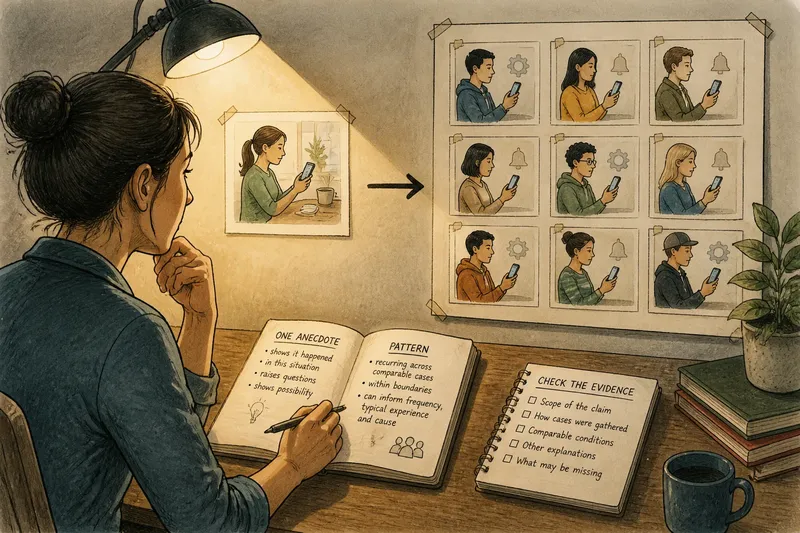
What can one vivid example really show? An anecdote can make a claim concrete, expose a possibility or prompt a useful question, but it rarely establishes how common something is or what caused it. To judge whether you have an anecdote or a pattern, look at what the example actually records and how it compares with other cases.
What can one anecdote show?
A single example can show that an event occurred in a particular situation, assuming the account is accurate. It can reveal what the event looked like, which details mattered to the person involved and what questions deserve closer attention.
Imagine a reader says a new note-taking app helped her remember appointments after she began putting them in one shared list. That account illustrates a possible use: recording appointments in a place she checks. It does not establish that the app improves memory for everyone, or that the app rather than the new routine made the difference.
An anecdote can also challenge an absolute statement. If someone claims that a certain process never causes delays, one credible instance of a delay may show that “never” is too strong. The example still cannot tell you how often delays occur or whether the process usually works well.
Think of an anecdote as a torch in a dark room. It can illuminate one corner clearly, but it does not show the shape of the whole room.
Why does a vivid story feel like strong evidence?
Stories give us a person, a sequence of events and a consequence to remember. That detail makes a case easy to picture. It can also make the case feel more representative than it is: a memorable account may stick in the mind precisely because it is unusual.
Vividness is not the same as reliability. Ask whether the speaker observed the event directly, whether the account leaves out relevant context and whether another explanation fits the same details. A precise story can still be incomplete, mistaken or selected because it supports a preferred view.
Keep two questions separate: “Could this happen?” and “How often does this happen?” One well-described case may answer the first. The second calls for a broader set of relevant cases.
When does a repeated pattern count as a pattern?
A pattern is a recurring feature across cases, not simply several stories that sound alike. The cases need to be comparable in the respect being discussed. If you are assessing whether a reminder system helps people arrive on time, for example, compare similar appointments and account for differences such as travel disruption or changes to the reminder routine.
Look at how the cases were gathered. A collection of accounts from people who chose to report a problem may tell you what problems can occur, yet say little about how common they are among all users. Cases selected because they fit a claim can create the same distortion.
A useful pattern description is bounded: it states what recurs, in which setting, and what the evidence does not settle. “Several users described missing alerts after changing phone settings” is narrower and more informative than “the app does not work”.
How should I compare an anecdote with a pattern?
Start with the claim you want to assess, then match the evidence to its scope. A claim about possibility needs less breadth than a claim about frequency, typical results or cause.
- For possibility: ask whether a credible case shows that the event can happen.
- For frequency: ask how cases were counted and whether the group reflects the population in the claim.
- For typical experience: compare cases that share the conditions that matter, including unsuccessful as well as successful outcomes.
- For cause: check whether other changes could explain the outcome and whether the proposed cause came before it.
- For a general rule: ask what evidence could reveal exceptions and how broadly the rule is meant to apply.
This is not a demand to dismiss personal accounts. A repeated, carefully gathered set of accounts can reveal a practical issue worth investigating. The point is to say what the set supports, rather than silently upgrading a group of stories into proof of a universal rule.
What questions help judge an example or a pattern?
Does one example prove that a claim is true?
It can support a narrow claim that an event happened, if the account is dependable. It cannot by itself establish that the event is common, typical or caused by the factor named in the claim.
Can one counterexample disprove a general claim?
It can defeat an absolute claim such as “this never happens” if the counterexample is credible and fits the claim’s terms. It does not show that the opposite generalisation is true.
How many examples make a pattern?
There is no useful fixed count apart from the question and the way cases were selected. Look instead for consistent recurrence across relevant cases, enough context to compare them and a clear account of what may be missing.
What if the accounts conflict?
Do not average conflicting stories into a confident conclusion. Check whether the cases differ in setting, timing, definitions or who was included; those differences may explain why the accounts diverge.
How can I phrase a claim that fits the evidence?
Use language that marks the boundary between observation and inference. “In this account, the change followed the new reminder” reports a sequence; “the reminder caused the change” makes a stronger claim that needs evidence about alternatives.
Say “this can happen” when an example establishes a possibility. Say “these cases suggest a recurring problem among the people described” when several comparable accounts point in the same direction. Avoid “everyone”, “always” and “proves” unless the evidence and the claim genuinely justify those words.
Say you are reviewing reports about a shared calendar that stopped sending alerts after users changed notification settings. If the reports describe that same sequence but provide no comparison with users whose settings stayed unchanged, you can reasonably say that altered settings appeared alongside missed alerts in those accounts. You cannot yet say that the change caused every missed alert; that narrower wording preserves the useful observation without overstating it.
When assessing an anecdote or pattern, keep the central distinction in view: a case can make a possibility visible, while a well-described pattern can show recurrence within its boundaries. Neither automatically answers every question about prevalence, typical experience or cause. The clearest argument names which of those questions its evidence can answer—and leaves the others open.