From Syllogisms to Everyday Arguments
Learn to map everyday arguments as premises and conclusions, so you can see what supports a claim, spot missing links and judge the reasoning fairly.
How can you tell whether an everyday argument actually supports its conclusion? Start by translating it into premises and a conclusion. From syllogisms to everyday arguments, the useful move is not to make ordinary speech sound formal; it is to expose the reasoning beneath it.
A syllogism is a compact argument in which premises are offered as support for a conclusion. For instance: all library books must be returned; this book is from the library; therefore, it must be returned. Real conversations are rarely so tidy. People add qualifications, leave premises unstated and mix evidence with requests. You can still inspect the structure by working through it in order.
Find the claim the speaker wants you to accept
Read or listen for the point the argument is trying to establish. This is its conclusion. It might be a factual claim, such as “the meeting should be moved”, or a recommendation, such as “we should send the draft today”. Do not mistake the first striking sentence for the conclusion; a speaker may give reasons before stating what they want.
Ask yourself: if I accepted this argument, what would I be expected to believe or do? Write that as one plain sentence. If several conclusions appear, separate them. “The room is noisy, the team cannot concentrate, and we should book another space” contains a description, a possible effect and a recommendation. The final recommendation is the claim that needs support, but the earlier statements may also need checking.
Keep the conclusion narrow enough to assess. “The draft needs more work” is easier to examine than “the whole project is a mess”. A broad claim can hide several different conclusions, each of which may need its own reasons.
Separate reasons from background and persuasion
Next, identify the statements offered as support. These are the premises. Look for words such as “because”, “since”, “given that” and “therefore”, but treat them as clues, not proof. A sentence beginning with “because” may introduce a reason; “therefore” may signal a conclusion. Speakers also use emphasis, tone or vivid detail to make a point feel supported when no relevant premise has been given.
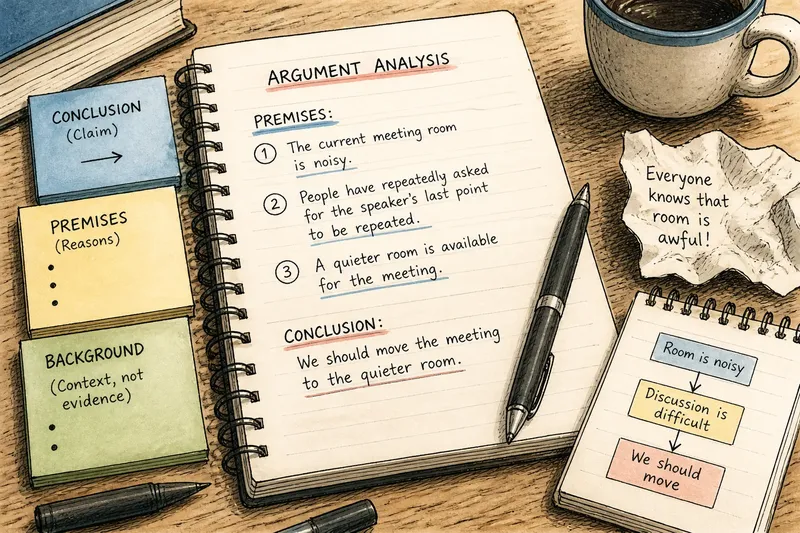
Consider: “We should move the meeting; the current room is noisy, and people keep asking for the last point to be repeated.” The recommendation is the conclusion. The noise and repeated requests are premises. “Everyone knows that room is awful” may add emphasis, but it is not automatically a separate reason.
Write each reason as a complete statement, then keep contextual material apart from it. A date, a person’s preference or a colourful description might help you understand the situation without supporting the conclusion. If you cannot explain how a sentence bears on the claim, do not quietly count it as evidence.
This is where a little editing helps. Remove rhetorical flourishes without changing the point. Treat the result like sorting tools into separate trays: each reason should be visible, and unrelated material should not be mistaken for support.
Put the argument into premise-and-conclusion form
Arrange the statements in a simple order. Number the premises, then put the conclusion after them. Keep the speaker’s meaning, but make grammar regular enough to compare the claims.
- Premise 1: The current meeting room is noisy.
- Premise 2: People have repeatedly asked for the speaker’s last point to be repeated.
- Premise 3: A quieter room is available for the meeting.
- Conclusion: We should move the meeting to the quieter room.
This version makes the structure visible, but it does not settle the argument. The premises may be true and relevant, yet the move could still be inconvenient or unnecessary. The form gives you a map of the reasoning, not a verdict on every statement.
If the argument uses a conditional, preserve its “if” relationship. “If the room is too noisy for discussion, we should move. The room is too noisy for discussion. So we should move.” The conclusion follows from the stated premises if the conditional is accepted. But “if we move, discussion will improve” does not by itself establish that we should move; a predicted benefit is not the same as a complete recommendation.
Check that each premise has a job
Now ask what each premise contributes. Does it support the conclusion directly, or does it support another premise that then supports the conclusion? For example, “the room is noisy” may support “the discussion is difficult”, which in turn supports “we should move”. When the links are chained, show them rather than leaping straight from the first claim to the last.
Also ask whether a premise is merely associated with the conclusion. The fact that a room is old does not by itself show that it is unsuitable. The fact that someone dislikes it does not establish that the whole group needs to move. A relevant premise should make the conclusion more reasonable, not simply mention the same topic.
For a combined argument, several premises may need to work together. “The room is noisy” and “the meeting depends on careful discussion” may jointly support moving; either one alone might be too weak. Mark such premises as a pair. This prevents you from judging one statement as though the speaker had offered it as the entire case.
Test whether the conclusion follows
Once the links are clear, ask what would have to be true for the conclusion to follow. In a deductive argument, the premises are intended to make the conclusion unavoidable: if every premise is true, the conclusion cannot be false. The library-book syllogism has this form because its first premise covers every library book and its second identifies this item as one of them.
Many ordinary arguments are not deductive. They offer a reason to expect a conclusion, while leaving room for exceptions. “The room has been noisy, so it may be hard to hold a discussion there” is a plausible inference, not an airtight result. A useful question is: could all the premises be true while the conclusion is false? If so, the argument may still give some support, but it does not establish the conclusion by deduction.
Imagine you are deciding whether to move a project meeting. The room is noisy, several people have asked for a quieter space, and another room is available. You could conclude that moving is sensible, but you should also consider whether the other room is accessible and whether the noise can be reduced without moving. Those possibilities do not erase the reasons; they show what else the decision rests on.
Look for a missing premise without inventing one
Ordinary arguments often leave a step unsaid because the speaker assumes the audience will supply it. “The room is noisy, so we should move” may rely on the unstated premise “We should move a meeting when noise makes discussion difficult and a suitable alternative is available.” Adding that premise makes the reasoning easier to inspect.
State a missing premise in neutral language, then ask whether the speaker would accept it and whether it is defensible. Do not strengthen the argument by adding an assumption the speaker never intended. If the missing idea is uncertain, phrase it as a possibility and ask for clarification.
Also distinguish a necessary bridge from a convenient extra reason. A bridge connects the premises to the conclusion. An extra reason may make the conclusion more persuasive, but the argument should not depend on it unless it was actually offered. This discipline helps you criticise the reasoning the person made, rather than a more extreme version of it.
Judge truth, support and scope separately
After mapping the argument, assess three different things. First, are the premises credible? Second, do they support the conclusion? Third, does the conclusion claim more than the premises warrant? Keeping these questions separate avoids a common mistake: treating a persuasive structure as proof that its statements are true.
A formally valid argument can start from a false premise. Conversely, a reasonable argument can have true premises and still offer only partial support. “Several people found the room distracting, so nobody can concentrate there” moves from some people to everyone. The premise may be accurate, while the conclusion overreaches.
Check the wording for changes in scope. Terms such as “some”, “most”, “all”, “always” and “could” do different work. If a premise says that some attendees struggled, it cannot support a conclusion about every attendee without another reason. Keep the conclusion at the same level of strength as its support.
What questions help with everyday arguments?
What is the difference between a premise and a conclusion?
A premise is a statement offered as a reason; a conclusion is the claim those reasons are meant to support. In an argument, the conclusion may appear at the beginning, middle or end.
Does a valid argument have to be true?
No. Validity concerns whether the conclusion follows if the premises are true. You still need to assess whether the premises themselves are credible.
How do I spot an unstated premise?
Ask what additional statement would connect the speaker’s reasons to the conclusion. Write the smallest plausible bridge, then check whether it is fair and acceptable rather than silently treating it as established.
Can an argument be reasonable without being certain?
Yes. Many practical arguments make a conclusion more likely or sensible without ruling out every alternative. Judge how much support the premises provide, not just whether they force the conclusion.
Use the map to respond fairly
When you reply, name the conclusion you think the speaker is defending, then restate the strongest premises in terms they would recognise. You can then challenge a particular part: question a premise, ask how it supports the conclusion, or point out that the conclusion is broader than the reasons allow.
Say you are discussing the noisy meeting room with a colleague. You might say, “I understand the case for moving: the room disrupts discussion and another space is available. Do we know that the other room is suitable for everyone?” That response accepts the structure without pretending the decision is settled.
Mapping from syllogisms to everyday arguments gives you a repeatable way to slow down a claim: identify its conclusion, lay out its premises, examine the links and check the scope. Use the map to locate the disagreement precisely. If you agree on the reasons but differ on the conclusion, the missing issue may be a value or a practical constraint, not a failure to understand the argument.